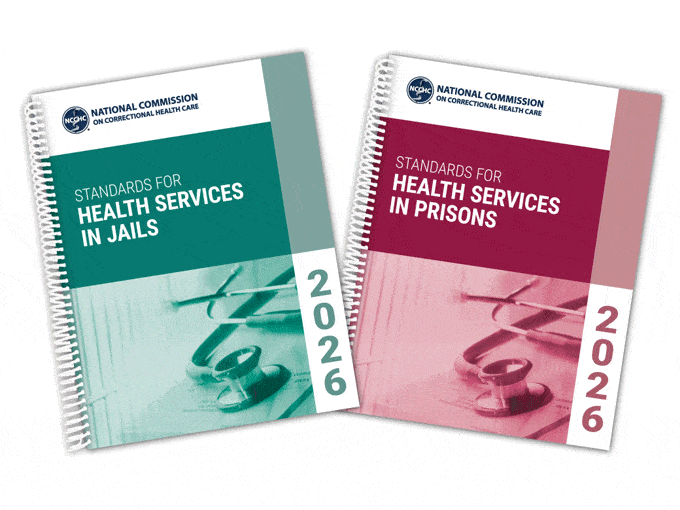
NCCHC has released the 2026 edition of the Standards for Health Services in Jails and the Standards for Health Services in Prisons. The Standards are the leading framework for quality improvement and accreditation in correctional health care. Building on the foundation of the 2018 editions, the 2026 Standards introduce updates, new guidance, and expanded requirements to better reflect current best practices, legal expectations, and the evolving needs of incarcerated populations.
Facilities seeking NCCHC accreditation will need to be in compliance with the new Standards starting January 1, 2026. The CCHP exam will reference the new Standards beginning February 25, 2026.
What’s New
The 2026 Standards reflect years of expert input and field-tested insights. Key enhancements include:
• New Section: Supporting Survey Documentation – Each standard now includes a detailed list of recommended documentation to guide facilities in preparing for NCCHC accreditation surveys.
• Expanded Interpretive Guidance – Formerly titled “Discussion,” this section now provides clearer explanations of compliance expectations, required elements, and best practices.
In addition, the Standards are available for the first time in an online digital format. The online format is a single-user license and allows annotation, but does not permit printing or network sharing.
Updated Requirements
• Standard D-06 on Patient Escorts was eliminated, but its provisions are included in Access to Care (A-01)
• Items required within a health record are now detailed in a compliance indicator within Health Records (A-08)
• An administrative review meeting is now required within 90 calendar days and the time period for completing a psychological autopsy for any suicide has been updated to 90 calendar days (A-09)
• A grievance log and discussion of grievances in CQI meetings are now required (A-10)
• Infection control and prevention requirements have been expanded to include information related to negative pressure rooms, management of communicable disease outbreaks, hand hygiene requirements, and disinfection (B-02)
• Annual health assessments and dental examinations are now required under Clinical Preventive Services (B-03).
• Continuation of verified contraception medication is now required upon admission to the facility (B-06)
• Adverse clinical events and near-miss events are now a required discussion in CQI meetings (B-08)
• Credentialing requirements were expanded and now also include telehealth services provided by qualified health care professionals, qualified mental health professionals and providers (C-01)
• Annual peer review requirements are now focused specifically on providers and licensed mental health professionals, while RNs and LPNs/LVNs require annual competency assessments (C-02)
• Additional training topics were added to health training requirements of custody staff (C-04)
• Additional training topics and the requirement of annual training were added to medication administration training to all staff who administer or deliver medications (C-05)
• Health Care Liaison (C-08) and Clinic Space, Equipment, and Supplies (D-03) have been updated to Essential from Important.
• A health care liaison is now required any time qualified health care professionals are not on-site (C-08)
• Additional training topics were added to health staff new hire orientation requirements (C-09)
• Substantial updates/changes were made to pharmaceutical operations to reflect current practice (D-01)
• Information pertaining to annual review of regular diets was joined with information on medical diets so all diet related information appears in one standard (D-05)
• A receiving screening is required within six hours of admission to the facility (E-02)
• An initial health assessment is now required on all incoming individuals (E-04)
• Additional topics were added to the initial mental health screening requirements (E-05)
• Initial oral exams may now be deferred under specific conditions (E-06).
• Discharge planning now includes mandatory support for applying for health insurance before release (E-10).
• A chronic disease management program is now required (F-01)
• Requirements were added for facilities with an acute residential mental health unit on-site (F-02)
• MOUD protocols and SUD services are addressed in a renamed and expanded F-03 standard.
• Additional requirements for pregnant patients, postpartum care, and pregnancy loss were added (F-05)
• Standards such as Infirmary-Level Care (F-06) and Care for the Terminally Ill (F-07) now apply to all facilities, regardless of whether these services are provided on-site.
• Contact frequency information has been updated for those in restrictive housing (G-02)
• Psychotropic medications now require documented informed consent (G-05)
New and Renamed Standards
One new Standard has been added as an Important standard, Gender-Affirming Health Care Services (F-08). This Standard gives guidance to facilities on providing multidisciplinary care to support and affirm gender identity.
These Standards have been renamed:
• A-02: Responsible Health Authority and Designated Health Staff (formerly Responsible Health Authority)
• A-07: Confidentiality and Privacy of Care (formerly Privacy of Care)
• A-09: Procedure in the Event of a Death (formerly Procedure in the Event of an Inmate Death)
• B-02 Infection Prevention and Control (formerly Infectious Disease Prevention and Control)
• B-06 Contraception Services (formerly Contraception)
• C-02: Clinical Peer Review and Competency Assessment (formerly Clinical Performance Enhancement).
• C-04: Health Training for Custody Staff (formerly Health Training for Correctional Officers)
• C-06: Incarcerated Workers In Health Services (formerly Inmate Workers)
• D-02: Medication Administration Services (formerly Medication Services).
• D-05: Nutrition Services (formerly Medical Diets)
• E-07: Nonemergent Health Care Requests and Services (formerly Nonemergency Health Care Requests and Services)
• E-08: Nurse-Initiated Protocols and Procedures (formerly Nursing Assessment Protocols and Procedures)
• F-01: Chronic Disease Management and Specialized Health Care Services (formerly Patients with Chronic Disease and Other Special Needs)
• F-03: Services for Substance Use Disorder (formerly Medically Supervised Withdrawal)
• F-05: Care of the Pregnant and Postpartum Patient (formerly Counseling and Care of the Pregnant Inmate).
• G-02: Restrictive Housing (formerly Segregated Inmates).
A Commitment to Quality
“These revisions reflect our commitment to continually advancing correctional health care,” said Amy Panagopoulos, BSN, RN, CCHP, Chief Nursing Office/Vice President of Accreditation. “The 2026 Standards integrate current medical knowledge, emphasize equity and access, and provide jails with the tools needed to deliver safe, ethical, and constitutionally appropriate care.”
“We could not have done this without the time, commitment, and expertise of many volunteers. These Standards will help facilities improve patient care, avoid adverse events, and improve safety for staff and the incarcerated,” said Wendy Habert, Director of Accreditation.
For More Information
The new Standards can be ordered now from the NCCHC online store. For more information, visit ncchc.org/online-bookstore.