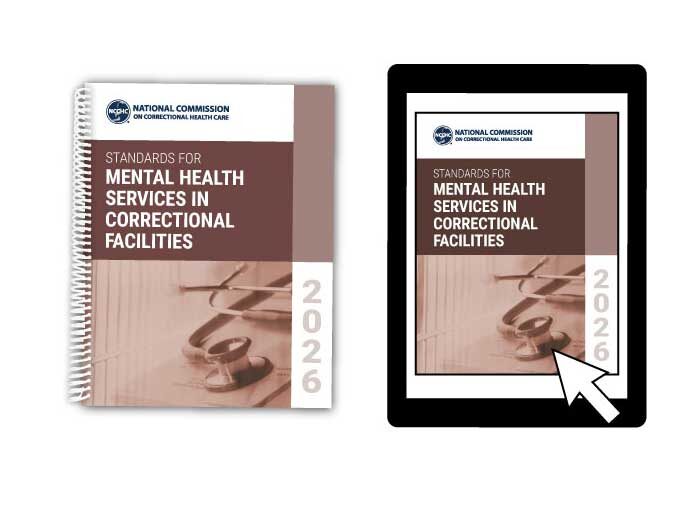
NCCHC is proud to announce the release of the 2026 edition of the Standards for Mental Health Services in Correctional Facilities, showcasing advancements in mental health care delivery and policy. Compared to the 2015 edition, the 2026 Standards reflect a fundamental change toward equity, clinical accountability, and modern best practices in correctional mental health.
“Mental health care in correctional facilities has entered a new era, and the 2026 Standards reflect that shift,” said Amy Panagopoulos, MBA, RN, CCHP, NCCHC Vice President of Accreditation/Chief Nursing Officer. “From suicide prevention to treatment planning, these updates prioritize the dignity and well-being of patients while equipping professionals with practical, clear, and modernized standards.”
What’s New: Key Concepts Introduced in 2026
1. Streamlined and Restructured
- The manuals have seven sections instead of nine and the number of Standards has been reduced to 52 from 58.
- Manuals have been reorganized to align with the structure of the 2026 Jail and Prison Standards.
- Interpretive Guidance has replaced the Discussion section, and every Standard includes a section on Supporting Survey Documentation.
2. Elevating the Role of Mental Health Professionals
The 2026 Standards expand the responsibilities and presence of qualified mental health professionals (QMHPs), including:
- Clear delineation of QMHP vs. QHCP roles for mental health screening and evaluation.
- Enhanced triage and referral expectations to ensure timely, clinically appropriate care.
3. Stronger Focus on Suicide Prevention
B-03: Suicide Prevention and Intervention in 2026 builds on the 2015 Standards but introduces safety precaution monitoring of individuals at risk of suicide as well as those who engage in self-harm, reinforces the use of closed circuit television to supplement monitoring but not substitute for direct staff observations, and now requires patient follow-up by a QMHP once an individual has been removed from safety precautions.
4. Modernized Terminology and Person-Centered Language
The 2026 edition removes outdated, stigmatizing language (e.g., “inmate with mental illness”) in favor of people-first terms like “individual receiving mental health care.”
5. Integrated Care and Cross-Disciplinary Coordination
- New emphasis on collaborative case management planning between custody, medical, and mental health staff.
- Mental health’s role in medical screenings is more explicitly defined, and joint documentation practices are encouraged.
- Facilities are guided to establish interdisciplinary treatment teams for patients with serious mental illness.
6. Mental Health in Restrictive Housing and Residential Units, as well as Workforce Preparedness
- The 2026 Standards take a more proactive, trauma-informed stance on both patient care and staff training.
- G-02: Restrictive Housing introduces stringent requirements for mental health rounds.
- New Standard C-09: Orientation for MH Staff requires basic and in-depth orientation for mental health staff. The required training should help support staff acclimate to the unique challenges of working in a correctional environment and raise their effectiveness in working with patients.
Why It Matters
“The 2026 updates go far beyond routine revisions—they represent a fundamental rethinking of how mental health care should be delivered in correctional settings,” said Wendy Habert, MBA, CCHP-A, Director of Accreditation. “We are deeply grateful to the many experts who generously contributed their time, insight, and talent to make these updates possible.”
Implementation Timeline
Facilities pursuing NCCHC mental health accreditation and must comply with the 2026 Mental Health Standards beginning April 1, 2026. The CCHP-MH exam will also require the 2026 edition starting April 1.
How to Order
The Standards can be ordered from the NCCHC online store. The Standards are available in print and digital access.